神雕侠侣
China, Indonesia pledge deeper strategic synergy, firm support for each other's core interests at strategic dialogue_我的网站

一 |
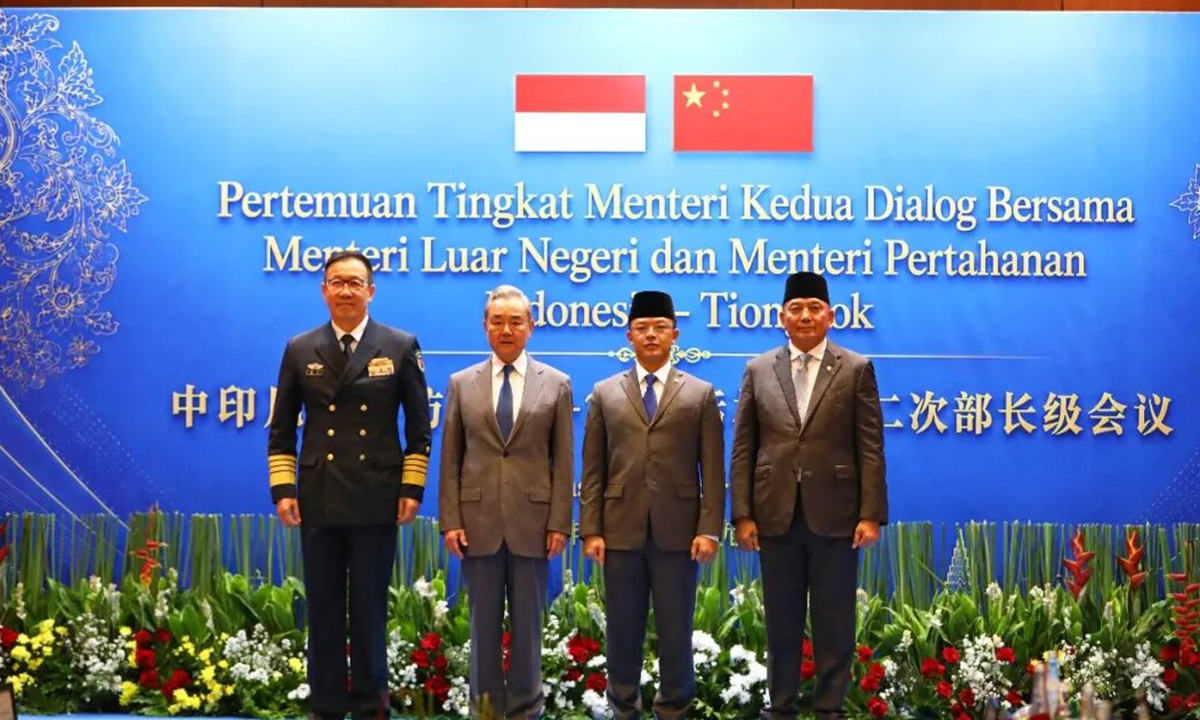
The Second Ministerial Meeting of China-Indonesia Joint Foreign and Defense Ministerial Dialogue Photo: Courtesy of Chinese Foreign Ministry China and Indonesia have agreed to deepen synergy of their development strategies, deepen cooperation across multiple sectors including maritime affairs, and firmly support each other's core interests, during the first Conference of the China-Indonesia Comprehensive Strategic Dialogue Mechanism held on Friday in Jakarta.
Chinese Foreign Minister Wang Yi and Indonesian Foreign Minister Sugiono co-chaired the conference. The two sides had an in-depth exchange of views on advancing the building of a China-Indonesia community with a shared future and reached broad consensus, according to Chinese Foreign Ministry's readout.
Wang said that the establishment of the comprehensive strategic dialogue mechanism is an important initiative for the two sides to implement the consensus reached by the two heads of state and advance the building of a China-Indonesia community with a shared future that enjoys regional and global influence.
Noting that China has always placed Indonesia in an important position in its diplomacy, particularly in neighborhood diplomacy, the Chinese top diplomat said China stands ready to work with Indonesia to strengthen all-round China-Indonesia cooperation, and pool greater development synergy to jointly tackle risks and challenges.
Stressing that the conference marks an important milestone in bilateral relations, Sugiono said China's development has brought enormous opportunities to the world, particularly neighboring countries such as Indonesia.
Sugiono added that Indonesia firmly adheres to the one-China policy and supports China's cause of reunification. Just in mid-August, the Chinese and Indonesian navies held a joint naval navigation exercise in waters east of China's Taiwan island.
The two sides also agreed to uphold strategic autonomy and firmly support each other's core interests. They also decided to launch the formulation of the China-Indonesia Five-year Action Plan (2027-2031).
The dialogue mechanism was established when Sugiono visited Beijing in April 2025.
Following the Conference of the China-Indonesia Comprehensive Strategic Dialogue Mechanism, the two sides also held a "2+2" meeting, pairing foreign and defense ministers in joint dialogue.
During the meeting between Chinese Defense Minister Dong Jun and his counterpart Sjafrie Sjamsoeddin on Friday, the two sides stated that under the strategic guidance of the heads of state of the two countries, the military-to-military relations face favorable development opportunities with broad prospects for cooperation.
Both sides should continue to strengthen military mutual trust, maintain close exchanges between the two militaries at all levels, deepen practical cooperation in multiple fields, and work together to safeguard regional peace and stability.
"Amid rising power politics, hegemonism, and protectionism, the first China-Indonesia Comprehensive Strategic Dialogue Mechanism conference has further enhanced strategic mutual trust and lifted bilateral relations to a new height," said Xu Liping, director of the Center for Southeast Asian Studies at the Chinese Academy of Social Sciences.
At its core, the mechanism does not target any third party; rather, it upholds win-win cooperation, peaceful development, and multilateralism while promoting collective self-strengthening of the Global South, said Xu. "It sets an example for the region and beyond, effectively offsetting extra-regional interference and noise from within and outside the region."
In specific areas, the two sides pledged to expand cooperation in areas such as artificial intelligence and poverty reduction. They agreed to restart cooperation in fishing, accelerate maritime cooperation and push forward joint development.
Both sides agreed that deepening cooperation in energy and mineral resources serves their common interests, and expressed readiness to jointly build a comprehensive, open and green partnership in energy and mineral resources.
Official data shows that China has been Indonesia's largest trading partner for 13 consecutive years, with bilateral trade reaching $167.49 billion in 2025, up 13.4 percent year-on-year. From the Jakarta-Bandung High-Speed Railway to industrial parks and other projects, the two sides have maintained a sound momentum of cooperation.
"As two important Global South countries with highly complementary economies, China and Indonesia have taken the lead in the region in integrating traditional sector cooperation with emerging economic cooperation," said Xu.
He added that Beijing-Jakarta cooperation is characterized by equal emphasis on and deep integration of traditional and new-quality productive forces. "Firmly grounded, multi-dimensional in scope, and rich in substance, it has become a bellwether for regional cooperation," Xu added.
In terms of the regional and global scope, the two sides also agreed to deepen cooperation within the framework of the four major global initiatives, strengthen policy coordination in multilateral mechanisms such as the United Nations and BRICS, oppose unilateral bullying and power politics, and safeguard international fairness and justice as well as the legitimate rights and interests of developing countries.
The two sides agreed to fully and effectively implement the Declaration on the Conduct of Parties in the South China Sea and work toward the early conclusion of the Code of Conduct (COC) in the South China Sea.
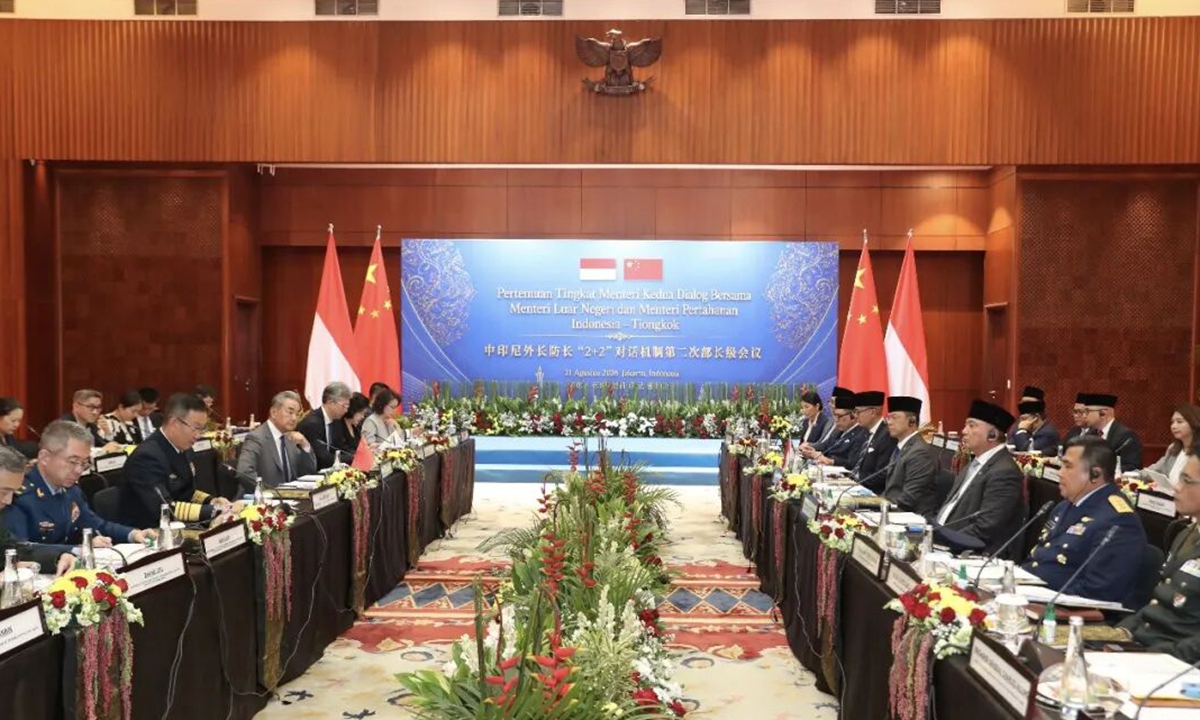
The Second Ministerial Meeting of China-Indonesia Joint Foreign and Defense Ministerial Dialogue Photo: Courtesy of Chinese Foreign Ministry
During the "2+2" meeting, the two sides agreed to deepen defense cooperation and promote the regularization and institutionalization of practical cooperation in areas including equipment and technology, joint exercises and training, personnel training, and maritime security, while continuously improving the quality and effectiveness of such cooperation, according to a readout released by the Chinese Foreign Ministry.
The two sides jointly advocate an Asian security model featuring shared security, and will work to uphold the mainstream of regional cooperation and peace and stability in the South China Sea, the readout said.
Amid attempts by certain countries to create trouble and fabricate confrontational false narratives in the South China Sea, China and Indonesia, both important South China Sea littoral states, are duty-bound to jointly safeguard regional peace and stability, said Xu. "Their consensus on this issue injects positive energy into the region, contributing to the early conclusion of the COC."
According to the expert, despite disputes, the overall situation in the South China Sea is manageable and stable, and the close cooperation between China and Indonesia demonstrates to the international community the broad trend and aspiration of peace, friendship, and cooperation in the region.
。

二 |
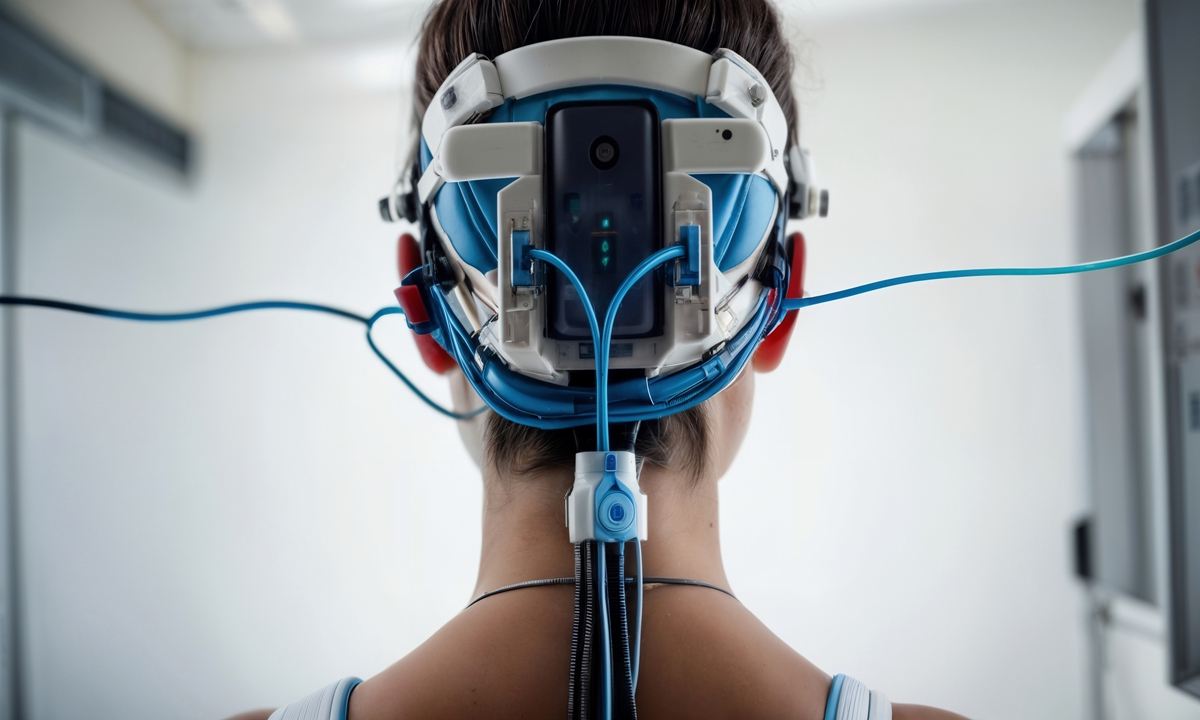
Photo: VCG
Chinese researchers have developed a multifunctional electrode coating that addresses key challenges in long-term brain-computer interface (BCI) implantation, including signal loss and tissue adhesion, bringing BCI one step closer to clinical application, the Global Times learned from the research team behind the findings on Sunday.
As an emerging field combining neuroscience and artificial intelligence (AI), BCI faces a major challenge of ensuring long-term compatibility between electrodes and brain tissue. Previous clinical trials showed that immune responses could cause implanted electrodes to retract after just three months, severely reducing signal quality and the number of available channels.
This problem stems from chronic inflammation triggered by implants, which creates insulating scar tissue around electrodes and separates them from neurons. Irreversible adhesion between electrodes and brain tissue after long-term implantation also makes device removal risky, potentially causing brain injury during follow-up surgeries.
Experiments showed that flexible neural electrodes coated with this material could operate stably in the brain for more than 300 days and could be safely removed without causing damage. This means the universal coating technology can make electrodes not only operate stably over the long term but can also be safely removed and replaced after aging, paving the way for long-term BCI applications.
Developed by the research team led by Zhang Wei at the Technical Institute of Physics and Chemistry, Chinese Academy of Sciences, associated with Beijing Tiantan Hospital, Shanghai Institute of Microsystem and Information Technology and NeuroXess, a high-tech life science company specializing in BCI technologies, the cationic alternating peptide electrode coating preserves electrode flexibility and conductivity, while offering antibacterial, anti-protein adsorption and immune-rejection-inhibiting functions.
A 300-day animal study showed the coating's effectiveness. Bare electrodes experienced a sharp loss of recording capability after 90 days of implantation and could barely detect neuronal signals after 300 days. In contrast, coated electrodes maintained stable recording channels and consistently captured neural signals above 155 microvolts.
In terms of neural modulation, after 300 days of implantation, conventional electrodes required a current of 100 microamps to induce weak limb responses, while coated electrodes triggered clear movements with only 2 microamps, improving modulation efficiency by 50 times.
Notably, the removal tests highlighted a key advantage of the coating that electrodes no longer form irreversible bonds with brain tissue. In the experiments, the coated electrodes were removed intact, with minimal damage to the surrounding brain tissue, Zhang told the Global Times on Sunday.
。
Current article:http://4yynrfu.cousizhegaobaolengkuo.bond/dw6/20260826/4087.html
Published on:00:24:20